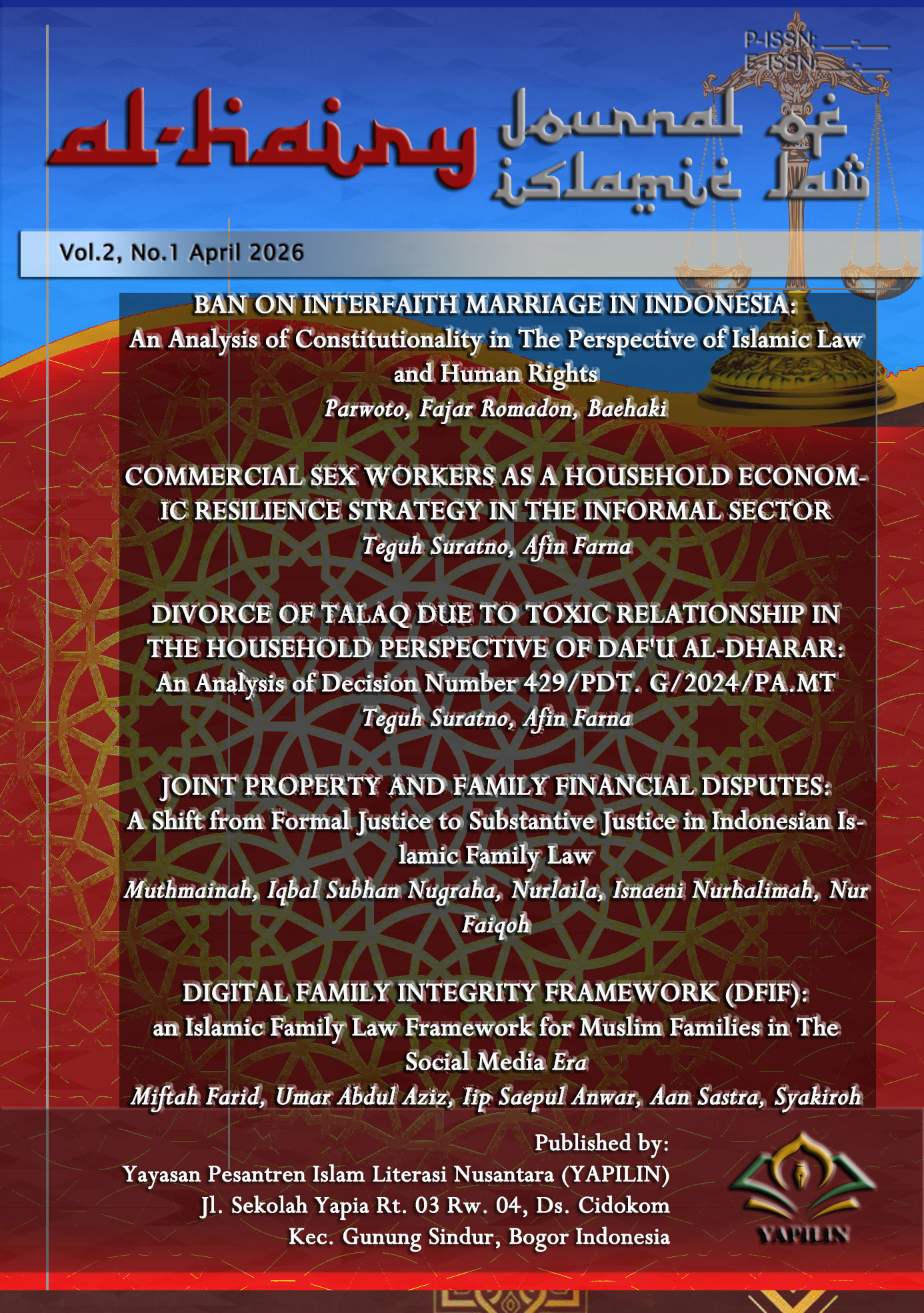
Divorce of Talaq Due to Toxic Relationship in The Household Perspective of Daf'u al-Dharar: An Analysis of Decision Number 429/PDT. G/2024/PA.MT
DOI:
https://doi.org/10.64344/hry.v2i1.104Keywords:
Divorce Talak, Toxic Relationship, Daf'u al-Dharar, Ratio Decidendi, Religious CourtAbstract
This study analyzes the judge's legal considerations in talaq divorce cases motivated by unhealthy domestic relationships and assesses its relevance to the principles of Daf'u al-Dharar. The focus of the research is directed at the Decision of the Metro Religious Court Number 429/Pdt.G/2024/PA.Mt. The research uses a juridical-normative method with a statutory approach, a case approach, and a conceptual approach. The primary legal material consists of court decisions, Government Regulation Number 9 of 1975, and the Compilation of Islamic Law. Secondary legal materials are in the form of journals and books on divorce, toxic relationships, fiqh rules, and maqashid al-shari'ah. The data was analyzed descriptive-analytically through the identification of legal facts, the assessment of ratio decidendi, and the interpretation of the principle of benefit. The results of the study showed that the judge granted the application verstek after the Applicant proved the existence of continuous disputes, separation of residence for about ten months, failure of peace, and no hope of living in harmony again. This fact fulfills Article 19 letter (f) of Government Regulation Number 9 of 1975 jo. Article 116 letter (f) of the Compilation of Islamic Law. The term toxic relationship is not used as a standalone legal reason, but serves as an analytical category to explain destructive communication patterns, loss of trust, emotional distress, and relationship fractures. Substantively, the verdict reflects Daf'u al-Dharar because divorce is placed as a last resort to stop psychic harm and protect the soul, intellect, dignity, and legal certainty of the parties.
References
Anam, Moch Khoirul, and Jumni Nelli. "Divorce in Front of Religious Courts According to Islamic Law and Positive Law in Indonesia: A Multidisciplinary Analytical Study." Journal of Indonesian Law 2, no. 1 (2021): 1–32.
Bold, Jasser. Maqāṣid al-Sharī'ah as Philosophy of Islamic Law: A Systems Approach. Herndon: The International Institute of Islamic Thought, 2008.
Baits, Ammi Nur. Introduction to the Rules of Fiqh Kubro. Muamalah Publishing, 2020.
Fathoni, Ahmad. "The Reactualization of the Rules of Al-Ḍarar Yuzāl in Contemporary Islamic Law." Al-Shi'ah Scientific Journal 18, no. 2 (2020): 150–152.
Be prepared, Lily. "Divorce Procedure Reviewed Based on Fiqh Law and Positive Law." Journal of Legal and Cultural Analytics 1, no. 1 (2022): 1–18.
Jamhuri. "The Concept of Talak According to Ibn Qayyim Al-Jauziyyah: An Analysis of the Time and Number of Talaq Falls." Media Sharia 20, no. 1 (2018): 95–122.
Kanda, Ageng Saepudin, and Ranti Kivania. "The Impact of Toxic Relationships on Mental Health." Sammajiva: Journal of Business and Management Research 2, no. 1 (2024). https://doi.org/10.47861/sammajiva.v2i1.790.
Kholik, Abdul. "The Concept of the Family of Sakinah, Mawaddah and Rahmah in the Perspective of Islamic Law." Journal of Mathematics 1, no. 1 (2019): 108–126.
Kurniawan, Adhi, et al. "The Success of Mediation in the Settlement of Talak Divorce at the Salatiga Religious Court: A Case Study of Case Number 353/Pdt.G/2023/PA. Sal." Usrah: Journal of Islamic Family Law 6, no. 2 (2025): 25–35.
Misnanto. "The Law of Imposing Talak Outside and Inside the Court." Al Fuadiy Journal 6, no. 1 (2023): 1–20. https://doi.org/10.55606/af.v6i1.691.
Munawarsyah. "Divorce as a Solution in Toxic Households: A Legal Analysis and Its Impact on the Family." Posita: Journal of Islamic Family Law 3, no. 1 (2025): 17–26. https://doi.org/10.52029/pjhki.v3i1.239.
Prasety, Fadia Dwi. "Getting to Know Toxic Relationship Behavior and Its Impact on Mental and Physical Health." INSIGHT: Journal of Counseling Guidance 13, no. 1 (2024): 1–5.
Son, Panji Adam Agus. "Application of the Rules of Lā Ḍarara wa Lā Ḍirār in Sharia Economic Law." Al-Kharaj: Journal of Sharia Economics, Finance & Business 6, no. 2 (2024): 2164–2179. https://doi.org/10.47467/alkharaj.v6i2.4391.
Rizky, Ahya Maulida Noor, et al. "Toxic Relationships in Islamic Law." Medina-Te: Journal of Islamic Studies 19, no. 2 (2023). https://doi.org/10.19109/medinate.v19i2.20280.
Student, Dedy. Children at the Crossroads of Divorce: Looking at the Parenting Style of Children of Divorce Victims. Surabaya: Airlangga University Press, 2020.
Tambun, Putri Cicilia, Novea Elysa Wardhani, and Syamhudian Noor. "Religious Court Judges' Considerations on Divorce on the Grounds of Brief House Separation: Study of Decision Number 375/Pdt.G/2024/PA.Plk." Al-Hikmah: Journal of Religion and Science 22, no. 1 (2025): 105–115.
Ulfiah. Family Psychology: Understanding the Essence of the Family and Handling Domestic Problems. Bogor: Ghalia Indonesia, 2016.
Vatanen, Raja Asyad, and Muhamad Arifin. "The Law of Origin of Talak in Islam: A Comparison of the Opinions of Ibn Taymiyah and Jumhur Ulama." Usrah: Journal of Islamic Family Law 6, no. 2 (2025): 146–164.
Windi, Pravita, Burhanatut Dyana, and Indah Listyorini. "Toxic Relationship Maintenance: Efforts to Prevent Domestic Violence in Marriage." Al Maqashidi: Journal of Islamic Law Nusantara 7, no. 1 (2024): 55–75.
Yusuf, Rendi, Baharudin Erlina, and Baharudin. "Analysis of Judges' Considerations in Divorce Lawsuits Based on Reasons for Disputes in the Household: A Study of Decision Number 17/Pdt.G/2021/PN.Tjk." Innovative: Journal of Social Science Research 1, no. 2 (2021): 87–96.
Zubaidah, Dwi Arini. "Analysis of Islamic Law on the Validity of Divorce in Laws and Regulations in Indonesia." Legitima 4, no. 2 (2022): 106–122. https://doi.org/10.33367/legitima.v4i2.2541.
Primary Legal Material
Indonesia. Law Number 1 of 1974 concerning Marriage as amended by Law Number 16 of 2019.
Indonesia. Government Regulation No. 9 of 1975 concerning the Implementation of Law No. 1 of 1974 concerning Marriage.
Presidential Instruction No. 1 of 1991 concerning the Dissemination of the Compilation of Islamic Law.
Metro Religious Court. Decision Number 429/Pdt.G/2024/PA.Mt.
Downloads
Published
Issue
Section
License
Copyright (c) 2026 Afin Farna, Afin Farna (Author)

This work is licensed under a Creative Commons Attribution-NonCommercial-ShareAlike 4.0 International License.