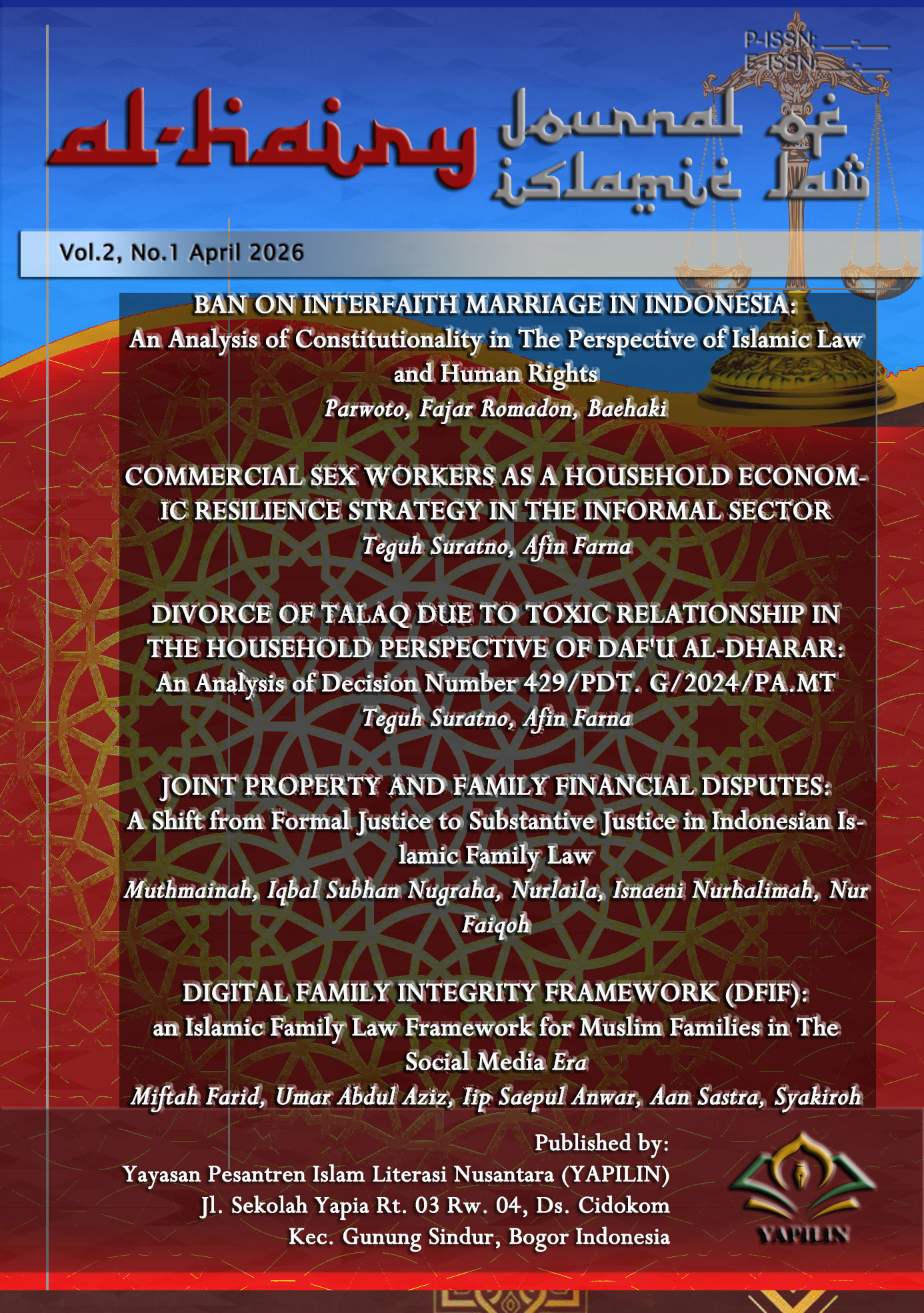
Digital Family Integrity Framework (DFIF): an Islamic Family Law Framework for Muslim Families in The Social Media Era
DOI:
https://doi.org/10.64344/hry.v2i1.109Keywords:
Islamic Family Law, Digital Family Integrity Framework, Muslim families, The Social Media EraAbstract
The development of social media has changed the character of family relationships by presenting various forms of digital interaction that affect communication, trust, commitment, and the quality of relationships in family life. Phenomena such as digital infidelity, cyber intimacy, oversharing, and the increasing intensity of virtual interactions show that the challenges faced by Muslim families in the digital age cannot be adequately explained through pre-developed family approaches. This research aims to develop the Digital Family Integrity Framework (DFIF) as a conceptual framework that integrates the principles of Islamic Family Law, maqāṣid al-syarī'ah, and the dynamics of contemporary digital relations to strengthen the integrity of Muslim families. This research is a normative legal research with a conceptual framework development orientation that uses a conceptual approach, a legislative approach, and a maqāṣid al-syarī'ah approach. The analysis was carried out through doctrinal analysis and conceptual synthesis of various legal sources and scientific literature related to Islamic Family Law, digital transformation, and family resilience. This research produced the Digital Family Integrity Framework (DFIF) which consists of five main dimensions, namely Digital Loyalty, Islamic Digital Communication Ethics, Family Privacy Protection, Online–Offline Relational Balance, and Digital Literacy. These five dimensions form a preventive conceptual model to maintain commitment, trust, ethics, and quality of Muslim family relationships in the digital space. This research contributes to the development of the study of Islamic Family Law by offering a preventive paradigm that complements the developed approach to family resilience and provides a conceptual foundation for empirical research and family policy development in the digital era.
References
Abbasi, Irum, and Nawal G Alghamdi. “When Flirting Turns Into Infidelity: The Facebook Dilemma.” The American Journal of Family Therapy 45, no. 1 (2017): 1–14. https://doi.org/10.1080/01926187.2016.1277804.
Alfarizi, Idris. “Batasan Privasi Dalam Hukum Islam: Analisis Fenomena Oversharing Di Media Sosial.” Jurnal Ilmu Hukum 1, no. 2 (2025): 56–65.
Alimuddin, Ahmad, and S R Naharuddin. “TRANSFORMASI KOMUNIKASI KELUARGA DI ERA MEDIA SOSIAL ANTARA KEHANGATAN TATAP MUKA DAN TANTANGAN PRIVASI DIGITAL.” Al-IHKAM Jurnal Hukum Keluarga Jurusan Ahwal Al-Syakhshiyyah Fakultas Syariah IAIN Mataram 17, no. 1 (2025): 148–64.
Auda, Jasser. Maqasid Al-Shariah as Philosophy of Islamic Law: A Systems Approach. London: International Institute of Islamic Thought, 2008.
Bourkibate, Abdessamad. “Family Cybersecurity Jurisprudence (FCJ): A Foundational Interdisciplinary Framework Integrating Islamic Legal Theory, Cybersecurity Engineering, and Digital Family Psychology,” 2026.
Castells, Manuel. The Rise of the Network Society. Second Edition with a New Preface. Wiley-Blackwell, 2020.
Creswell, John W, and J David Creswell. Research Design: Qualitative, Quantitative, and Mixed Methods Approaches. 6th ed. Thousand Oaks, CA: SAGE Publications, 2023.
Drouin, Michelle, Brandon T McDaniel, Jessica Pater, and Tammy Toscos. “How Social Networking Site Use Influences Romantic Relationships: A Systematic Review.” Computers in Human Behavior Reports 6 (2022): 100187. https://doi.org/10.1016/j.chbr.2022.100187.
Ellison, Nicole B, and Danah M Boyd. “Sociality Through Social Network Sites.” In The Oxford Handbook of Internet Studies. Oxford University Press, 2013. https://doi.org/10.1093/oxfordhb/9780199589074.013.0008.
Guspidawati, Lenny, and Jumni Nelli. “Reconstructing Marriage Agreements in Islamic Family Law: An Integrative Analysis of Fiqh, Maqāṣid Al-Syari’ah, and Indonesian Positive Law.” Jurnal Ushuluddin 33, no. 2 (2025): 635–52.
Hair, Joseph F, William C Black, Barry J Babin, and Rolph E Anderson. Multivariate Data Analysis. 9th ed. Cengage Learning, 2022.
Haqiqi, Muhamad Jihad Al, Annisa Jannatus Salim, and Lukman Santoso. “Enhancing Family Resilience in Society 5.0: A Study from Islamic Psychology and Maqashid Shari’ah Perspective.” Sakina: Journal of Family Studies 8, no. 3 (2024): 400–416.
Kamali, Mohammad Hashim. Shari’ah Law: An Introduction. Oneworld Publications, 2008.
McDaniel, Brandon T, and Sarah M Coyne. “Technoference: The Interference of Technology in Couple Relationships and Implications for Family Functioning.” Current Opinion in Psychology 32 (2020): 82–87. https://doi.org/10.1016/j.copsyc.2019.06.027.
McDaniel, Brandon T, Michelle Drouin, and Jaclyn D Cravens. “Do You Have Anything to Hide? Infidelity-Related Behaviors on Social Media Sites and Marital Satisfaction.” Computers in Human Behavior 66 (2017): 88–95. https://doi.org/10.1016/j.chb.2016.09.031.
Musarrofa, Ita, Husnul Muttaqin, and Ridha Amaliyah. “The Problems of Islamic Family Law in the Digital Era and Its Relevance to Renewal of the Compilation of Islamic Law.” Jurnal Hukum Islam 22, no. 1 (2024): 89–124.
Prime, Heather, Mark Wade, and Dillon T Browne. “Risk and Resilience in Family Well-Being During the COVID-19 Pandemic.” American Psychologist 75, no. 5 (2020): 631–43. https://doi.org/10.1037/amp0000660.
Qian, Yue, and Yang Hu. “The Digitalization of Family Life: A Multilevel Conceptual Framework.” Journal of Marriage and Family 86, no. 5 (2024): 1160–83.
Rofiq, Ahmad. Hukum Perdata Islam Di Indonesia. Jakarta: Rajawali Pers, 2021.
Rohman, M. “Dinamika Konflik Keluarga Era Digital: Pengaruh Media Sosial Terhadap Hubungan Keluarga. MASADIR: Jurnal Hukum Islam, 4 (02), 911–929,” 2024.
Rohman, Miftakur. “Dinamika Konflik Keluarga Era Digital: Pengaruh Media Sosial Terhadap Hubungan Keluarga.” Masadir: Jurnal Hukum Islam 4, no. 02 (2024): 911–29.
Rosli, Fatin Syahirah, Nur Najwa Zahari, Nur Izzati Faizolakhman, and Mohd Harifadilah Rosidi. “The Influence of Social Media on Marital Conflict: An Analytical Study through the Lens of Maqasid Al-Shariah in Preserving Family Stability and Dignity.” International Journal of Research and Innovation in Social Science 9, no. 7 (2025): 598–608.
Sholihah, Hani, and Sri Nurhayati. “Child Protection in the Digital Age through Education in the Islamic Educational Environment.” Journal of Islamic Education 9, no. 1 (2024): 200–218.
Situmorang, James Rianto. “Kesiapan Masyarakat Indonesia Hidup Di Era Digital.” Cerdika: Jurnal Ilmiah Indonesia 5, no. 7 (2025).
Solekhan, Muhammad. “Communication Ethics in Social Relationships Using Social Media Wisely in Islamic Values.” Journal of Modern Islamic Studies and Civilization 1, no. 01 (2023): 1–11.
Taufiqurohman, Taufiqurohman, and Nelli Fauziah. “The Evaluation of Maqāṣid Asy-Syarī’ah on Discourses of the Islamic Family Law.” El-Usrah: Jurnal Hukum Keluarga 6, no. 1 (2023): 81–90.
Turkle, Sherry. Reclaiming Conversation: The Power of Talk in a Digital Age. Penguin Press, 2015.
UNESCO. “Digital Literacy Global Framework 2.0.” UNESCO Institute for Statistics, 2023.
Walsh, Froma. “Family Resilience: A Developmental Systems Framework.” European Journal of Developmental Psychology 13, no. 3 (2016): 313–24.
Whitty, Monica T, and Laura-Lee Quigley. “Emotional and Sexual Infidelity Offline and in Cyberspace.” Journal of Marital and Family Therapy 34, no. 4 (2008): 461–68. https://doi.org/10.1111/j.1752-0606.2008.00088.x.
Wu, Nan, and Siti Ezaleila Mustafa. “Effects of Social Media Use on Family Relationship Quality: A Systematic Review.” In Forum Komunikasi, 19:195–225. Faculty of Communication and Media Studies (FCMS), 2023.
Downloads
Published
Issue
Section
License
Copyright (c) 2026 Miftah Farid, Umar Abdul Aziz, Iip Saepul Anwar, Aan Sastra, Syakiroh Syakiroh (Author)

This work is licensed under a Creative Commons Attribution-NonCommercial-ShareAlike 4.0 International License.