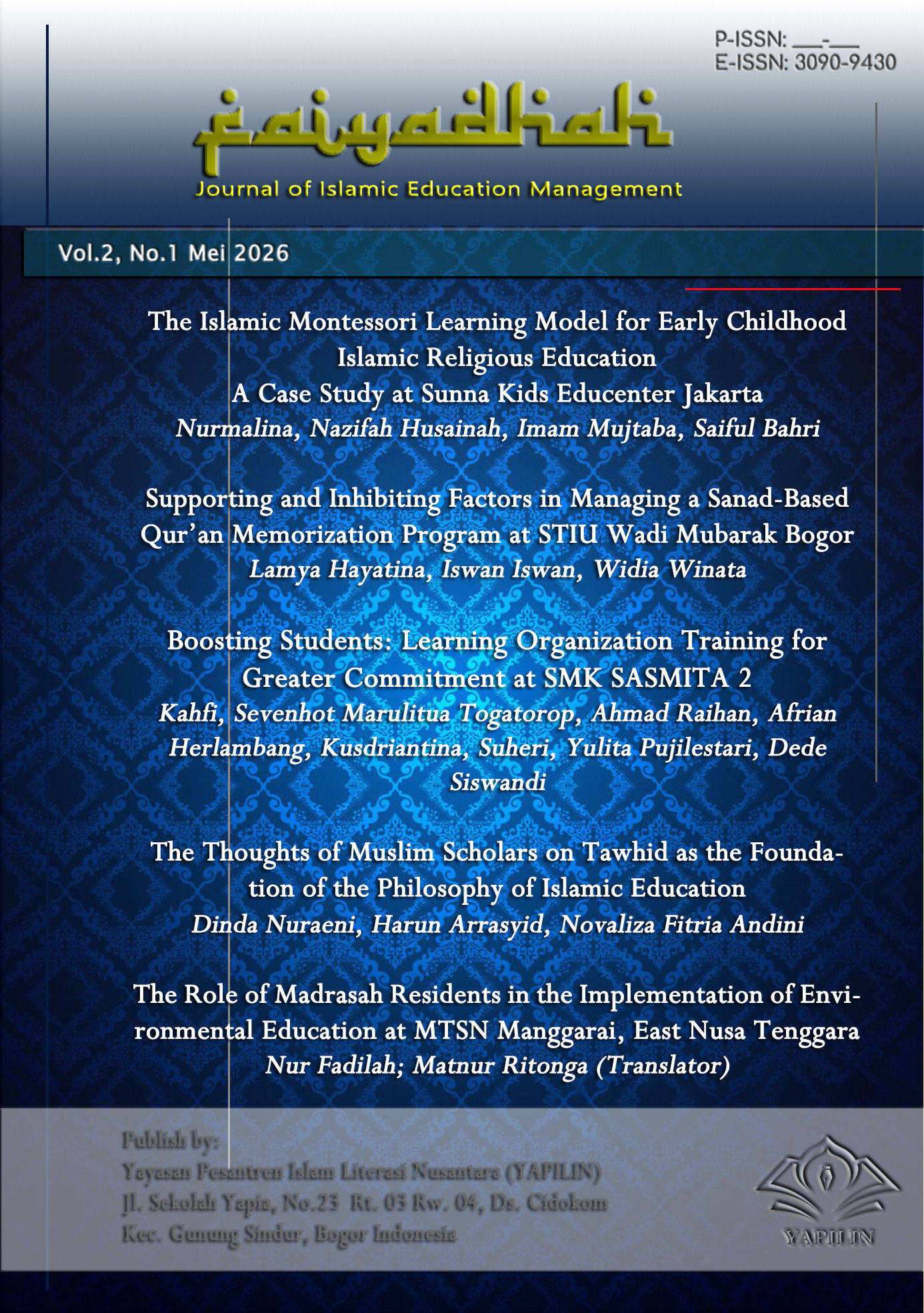
Supporting and Inhibiting Factors in Managing a Sanad-Based Qur’an Memorization Program at STIU Wadi Mubarak Bogor
DOI:
https://doi.org/10.64344/fydh.v2i1.83Keywords:
Sanad-Based Tahfidz, Supporting Factors, Inhibiting Factors, Islamic Education Management, STIU Wadi Mubarok BogorAbstract
ABSTRACT
This study aims to identify the supporting and inhibiting factors in the sanad-based tahfidz program at STIU Wadi Mubarak Bogor. This research employs a qualitative approach using a case study method, integrating observation, in-depth interviews, and documentation as primary data collection techniques to obtain comprehensive and in-depth findings. The results indicate that the main supporting factors include effective and visionary leadership, competent sanad-certified teachers, strong parental support, the availability of scholarships and donor contributions, students’ intrinsic motivation, and ongoing teacher professional development. These elements interact dynamically and synergistically in shaping a conducive, structured, and sustainable Qur’anic learning ecosystem that supports the quality of memorization. On the other hand, the inhibiting factors consist of psychological-individual dimensions, such as laziness, boredom, decreased motivation, psychological pressure, and health-related issues, as well as structural-systemic dimensions, including tight academic schedules, lack of discipline among participants, and distractions caused by uncontrolled gadget usage. The findings underscore that the success of a sanad-based tahfidz program is highly dependent on comprehensive and balanced management of both psychological and systemic aspects. This study offers practical implications for Islamic educational institutions in formulating strategic policies to improve memorization quality and ensure the sustainability of sanad transmission.
References
Al Hafiz, M. M., Yusof, M. F., Ghazali, M. A., & Md. Sawari, S. S. (2016). Historiography of Quranic Memorization from the Early Years of Islam until Today. Mediterranean Journal of Social Sciences, 7(1), 279–283. https://doi.org/10.5901/mjss.2016.v7n1s1p279
Al-Suyūṭī, J. al-D. (1996). Tadrīb al-Rāwī fī Sharḥ Taqrīb al-Nawāwī. Beirut: Dār al-Kutub al-‘Ilmiyyah.
Ameen Abdullateef, Olowolelu Abdulrasheed, D. M. (2017). Factors Inhibiting Effective Management of Tertiary Education In Kwara State: Evidence from the Colleges of Education. Sahel Alayst, 68–86.
Andayani, A., & Haq, Z. (2024). Jejaring Sanad Al-Qur'an (Studi Kasus Rumah Tahfiẓ Al-Qur'an di Jakarta). Innovative: Journal Of Social ScienceResearch, 4(1), 7549–7562. http://j-innovative.org/index.php/Innovative/article/view/8313%0Ahttps://j-innovative.org/index.php/Innovative/article/download/8313/5986
Ayatin L.N, F., & Fadlillah, F. (2023). Pesantren and the Transmission of Sanad Al-Qur’an: Tracking Sanad Tahfiz Connections in Indonesia. MUSHAF: Jurnal Tafsir Berwawasan Keindonesiaan, 3(2), 139–159. https://doi.org/10.33650/mushaf.v3i2.7244
Emilda Kholifah Arifah, & Triana Rosalina Noor. (2025). Analysis of Supporting and Inhibiting Factors in Learning at Community Learning Activity Centers. International Journal of Education Management and Religion, 2(1), 36–45. https://doi.org/10.71305/ijemr.v2i1.158
Fitriani, S., Suhayyatman, & Hartono, R. (2025). Determinasi Motivasi Belajar Siswa Dan Implikasinya Pada Praktik Pembelajaran: Sebuah Systematic Literature Review. Integrative Perspectives of Social and Science Journal(IPSSJ), 2(6), 8811–8818. https://ipssj.com/index.php/ojs/article/view/1030
Haris, A. R. (2023). Model synergy of Tahfiz Al-Quran programs in Wadi Mubarak Islamic Boarding School, Bogor. Ta’dibuna: Jurnal Pendidikan Islam, 12(6), 535–550. https://doi.org/10.32832/tadibuna.v12i6.15367
Hassan, A. Bin. (2020). Argumentation among Qurra’ Based on Sanad of Al-Quran. International Journal of Academic Research in Business and Social Sciences, 10(12), 78–90. https://doi.org/10.6007/ijarbss/v10-i12/8220
Ilyasin, M., & Muadin, A. (2021). Manajemen Disiplin Siswa Dalam Penguatan Sumber Daya Manusia (SDM) Modern. Southeast Asian Journal of Islamic Education, 03(02), 241–257.
Janna, M. M., Sirait, S., & Arif, M. (2025). Pendidikan Agama Islam dalam UU Nomor 20 Tahun 2003 tentang Kebijakan Sistem Pendidikan Nasional. Kuttab, 9(1), 226–242. https://doi.org/10.30736/ktb.v9i1.2406
Karina, A. (2025). Strategi perencanaan dalam manajemen pendidikan: Kajian teoretis. Pedagogy, 12(2), 7–15.
Lamya Hayatina, I. (2026). Kemampuan Membaca Al-Qur’an Pendidik Agama Islam: Tracer Alumni PTKI Jakarta Banten. Reslaj: Religion Education Social Laa Roiba Journal, Volume 8, 148–157. https://doi.org/10.47476/reslaj.v8i3.11085
Miles, M. B., Huberman, A. M., & Saldana, J. (2019). Qualitative Data Analysis: A Methods Sourcebook (4th edition). In SAGE Publications, Inc. (Vol. 16, Issue 2).
Ratu Amalia Hayani, Syafri Yanto, Azwar Rahmat, Agung Cucu Purnawirawan, & Aslan, A. (2024). Efektivitas Kepemimpinan Dalam Manajemen Pendidikan Islam. Jurnal Ilmiah Edukatif, 10(2), 136–148. https://doi.org/10.37567/jie.v10i2.3272
Terry, G. R. (1976). Principles of Management. Homewood, IL: Richard D. Irwin, Inc.
Thontawi, M., MY, M., Chaniago, F., Fiqhi, A., Hazairin, I. N., & Afifah, Y. (2022). Tahfidz Al-Qur’an: A Study of Learning Management Systems in Higher Education. AL-TANZIM: Jurnal Manajemen Pendidikan Islam, 6(1), 574–585. https://doi.org/10.33650/al-tanzim.v6i2.3535
Wais Al Qorni, A. (2021). Manajemen Rekrutmen Santri Tahfidz Al Qu’ran Tingkat Madrasah Aliyah. Rayah Al-Islam, 5(02), 506–513. https://doi.org/10.37274/rais.v5i02.480
Yin, R. K. (2016). Qualitative Research from Start to Finish, Second Edition. In The Guilford Press, New York (Vol. 3, Issue 1). http://dx.doi.org/10.1016/j.bpj.2015.06.056%0Ahttps://academic.oup.com/bioinformatics/article-abstract/34/13/2201/4852827%0Ainternal-pdf://semisupervised-3254828305/semisupervised.ppt%0Ahttp://dx.doi.org/10.1016/j.str.2013.02.005%0Ahttp://dx.doi.org/10.10
Downloads
Published
Issue
Section
License
Copyright (c) 2026 Lamya Hayatina, Iswan Iswan, Widia Winata (Author)

This work is licensed under a Creative Commons Attribution-NonCommercial-ShareAlike 4.0 International License.